Let's talk about the thing nobody mentions
Performance anxiety during sex isn't about being bad in bed. It's about believing you might be. That distinction changes everything because the anxiety itself is what actually kills the pleasure. Your brain gets so busy monitoring whether you're doing it right that it can't actually feel anything.
Here's the paradox: the harder you try to perform, the further your nervous system moves away from the state it needs to be in to have an orgasm. You tense up. Your breathing gets shallow. Your clitoris basically goes into hiding. And then you feel worse about the whole thing.
Lemon vibrators are one of the most direct ways out of this trap because they do something your anxious brain can't ignore. They create sensation so reliable and focused that your mind stops narrating the performance and starts responding to what's actually happening.
Why performance pressure hijacks your nervous system
When you're worried about how you look, how long it's taking, whether your partner is bored, or if you're doing something wrong, your sympathetic nervous system (your fight-or-flight system) activates. That system is great for running from danger. It is catastrophic for orgasms.
Arousal needs your parasympathetic nervous system. That's the rest-and-digest system. It's what lets your blood vessels dilate, your breathing deepen, and your muscles relax. These two systems can't run simultaneously. When performance anxiety is high, parasympathetic activation is nearly impossible.
The clinical term is spectatoring. It's when you're inside the experience but also watching it from outside. Judging it. Grading it. You become an audience member in your own body.
Women are socialized into this from early on. You learn to monitor how you look during sex, whether you're reacting the way you're supposed to, whether you're taking too long, whether your partner is satisfied. That voice in your head becomes so automatic you barely notice it's there. Until it prevents you from coming at all.
How clitoral vibrators interrupt the anxiety loop
Lemon sexual toys, especially clitoral vibrators like the Lem, work by creating such direct, consistent stimulation that your brain physically can't sustain the anxious narration. The sensation is too strong. Your nervous system has to attend to what's happening.
This is why suction-based lemon vibrators are particularly effective for performance anxiety. The sensation is novel. Your brain hasn't habituated to it yet. When you're experiencing something new and intense, the prefrontal cortex (your thinking, judging brain) has to take a back seat.
You're not thinking about whether you're performing well. You're thinking "oh, that's happening right now." That shift from narrative to sensation is the actual mechanism of anxiety relief.
Another reason lemon clitoral vibrators help: they put you in control. Your partner isn't responsible for your pleasure. You're not waiting for them to do it right. You're doing it. That agency itself quiets the performance anxiety. You get to decide the speed, the pattern, the pressure. There's no audience. There's no script.
Solo play as anxiety deconditioning
If you've spent years in performance mode during sex, your body has learned to associate sexual arousal with anxiety. That's a strong conditioning. You can't think your way out of it. You have to recondition your nervous system through direct experience.
Using lemon adult toys alone is the fastest way to break that association. In solo play, there's nobody watching. Nobody waiting. Nobody you need to impress. You can take 45 minutes. You can stop and start. You can explore what actually feels good instead of what you think is supposed to feel good.
Start in a space where you feel physically safe and won't be interrupted. That matters more than mood lighting or whatever else. Your nervous system needs to know you're genuinely alone and unobserved.
When you first start, don't make it about reaching an orgasm. That's just another performance metric. Make it about noticing sensation. What pattern feels best? What pressure? What rhythm? Can you feel the difference between a pattern your brain thinks you should like and one your body actually responds to?
After a few sessions of this, something shifts. Your nervous system starts to remember that arousal can happen without judgment. That pleasure is possible without an audience. That you can respond to your own body without monitoring it.
Building back into partnered intimacy without the pressure
Once you've broken the anxiety association in solo play, you can bring that into partnered sex without it reinstalling itself immediately.
The key is transparency. If performance anxiety is a real issue for you, your partner deserves to know that. Not as "I have a problem" but as "my brain sometimes gets in the way of my pleasure, and here's what helps." If your partner responds with judgment or pressure, that tells you something important about whether they're safe for you. And that's separate information from whether you can have pleasure.
One approach: bring your lemon vibrator into partnered play. Use it yourself while your partner is present. You're still in control. You're still the one managing the sensation. But your partner gets to watch, to participate, to feel your pleasure happening. That's different from performing for them. That's them witnessing something real.
Another approach: use solo play with lemon clitoral vibrators as a warm-up before partnered sex. Spend 15 minutes with your vibrator, get your parasympathetic nervous system activated, get blood flow to your clitoris, get your brain out of narrative mode. Then bring that activated state into partnered sex. You're not starting from zero anxiety. You're starting from a place where pleasure is already happening.
The conversation with your partner that actually helps
If you're in a relationship and performance anxiety is present, the conversation isn't about your vibrator. It's about the underlying dynamic.
Performance anxiety often shows up in relationships where there's unspoken pressure. Maybe your partner wants sex more than you do, and you feel obligated. Maybe you sense they're impatient for you to come. Maybe there's a dynamic where your pleasure is secondary to theirs.
You can't use a lemon vibrator to solve a relational problem. What you can do is use it to buy yourself time while you have the real conversation.
That conversation looks like: "I notice my brain gets in the way during sex. I'm working on that solo first so I can show up better with you. I'm not asking you to do anything different. I'm just saying this is what's true for me right now."
If your partner can hold that without making it about them, you have room to heal. If they push back or make it about their needs, that's important information.
What changes when the pressure lifts
Once performance anxiety loses its grip, people usually report that their orgasms get better, their desire goes up, and partnered sex becomes genuinely fun instead of emotionally loaded. That's not because the vibrator is magic. It's because your nervous system finally has permission to do what it's built to do.
You might find that you need the vibrator less over time. Or you might find you love using it. Both are fine. The point isn't to become dependent on a device. The point is to use it as a tool to prove to your nervous system that pleasure without performance is possible.
Lemon vibrators work because they're specific, consistent, and entirely under your control. That control is what breaks the anxiety loop. Once you remember what that feels like, it's available to you even without the device.

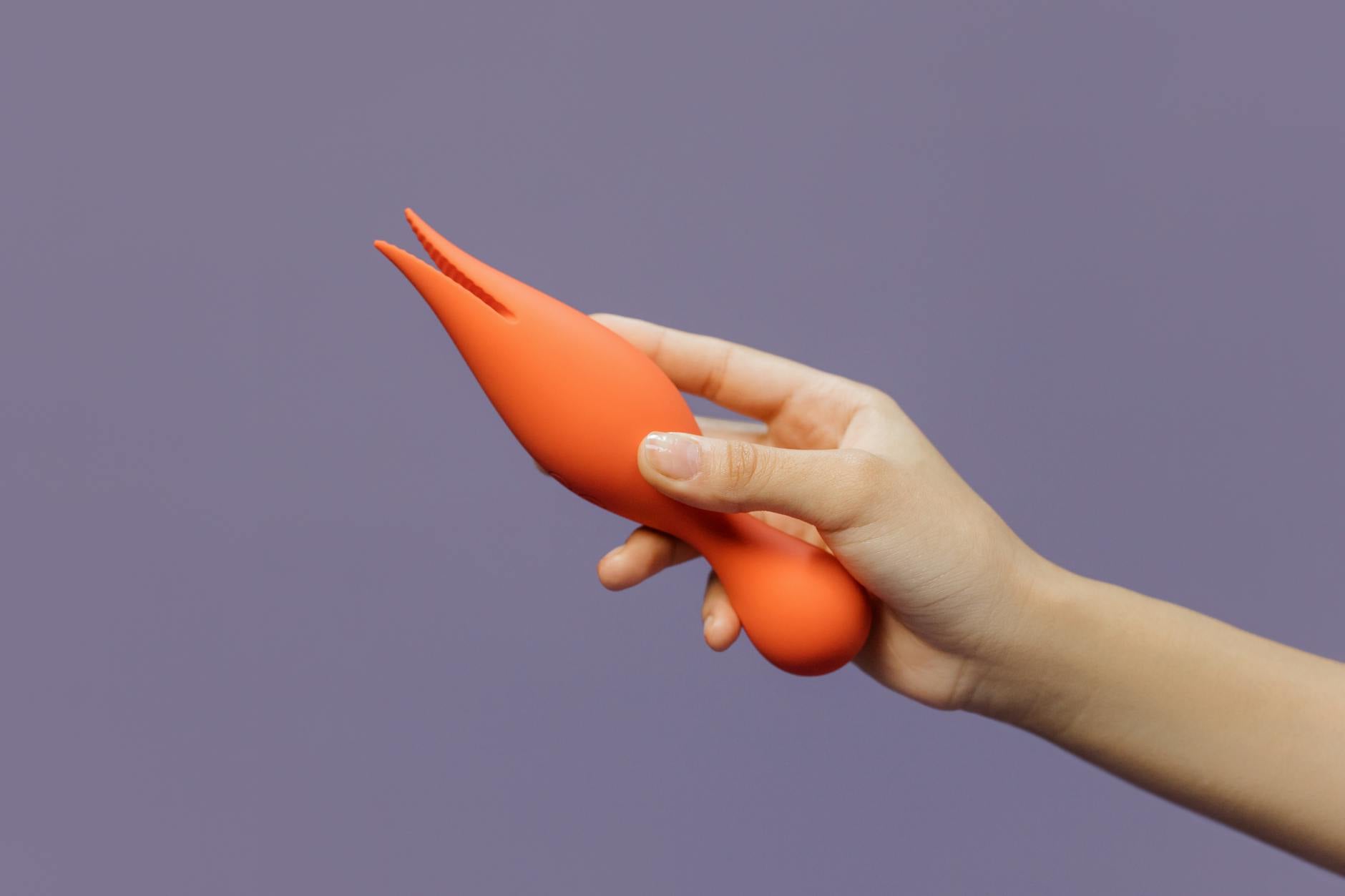
Photo by Olga Lioncat on Pexels
Getting started with lemon clitoral vibrators for anxiety relief
If you're buying your first lemon vibrator and anxiety is the reason, here's what matters: something quiet, something you control entirely, something that doesn't have a confusing button sequence. You want to focus on sensation, not on figuring out the device.
The Lem is built specifically for this. It's intuitive. The intensity ramps from barely-there to intense over a few patterns. You're not hunting through 12 modes trying to find the right one. You're just discovering what your body responds to.
Water-based lubricant helps. Even though suction-based lemon vibrators don't need as much lube as other toys, a little bit helps the seal and makes the whole experience feel less clinical and more sensual.
Start with lower intensities. Performance anxiety often comes with a body tension, and a gentler stimulation helps you relax into it. You can always turn it up. You can't undo turning it up too far.
Common questions about using lemon vibrators with performance anxiety
Will using a vibrator make it harder to come without one?
Not in the way you're probably worrying about. Your clitoris isn't going to "forget" how to respond to partner stimulation. What can happen is that you get used to a specific intensity and pattern, and then partner touch feels less intense by comparison. That's solvable. It just means your partner might need to be more direct with touch or you might need to use the vibrator during partnered play. This is actually a feature, not a bug, because it gives you permission to ask for what you need.
What if my partner feels threatened by the vibrator?
That's usually about insecurity or outdated beliefs about what sex should look like. If your partner feels like a vibrator is competition, what they're really saying is that your pleasure matters less than their ego. That's a relationship conversation, not a vibrator conversation. You might check out How to Use Lemon Vibrators With Partners Who Are Hesitant About Toys for specific language.
How long should I use the vibrator before trying partnered sex again?
There's no formula. Some people feel the shift after a few sessions. Others need a few weeks of consistent solo play before their nervous system really begins to trust that pleasure is safe. The key is noticing when you stop monitoring yourself and start responding. That's when the reconditioning is taking effect.
Can I use a lemon vibrator if I'm on anxiety medication?
Yes. Anxiety medications don't prevent pleasure. If anything, they create space for it by calming your nervous system. That said, some medications do blunt sensation. If that's you, How Lemon Vibrators Work With Medication-Induced Numbness has specific strategies.
What if I'm worried the vibrator will make me feel worse about my anxiety?
Some people worry that needing a vibrator means something is wrong with them. It doesn't. It means you're using a tool to help your nervous system do what it's built to do. That's not weakness. That's intelligence. Your anxiety isn't a character flaw. It's a nervous system pattern. Lemon vibrators help you interrupt that pattern. That's the entire point.
Should I tell my partner I'm using the vibrator for performance anxiety specifically?
You don't have to tell them anything about why you're using it. Your sexual pleasure is yours. That said, if performance anxiety is affecting your partnered sex life, your partner should know that's what's happening so they don't interpret it as disinterest in them. The conversation is "my brain gets in my way" not "you're the problem."
What happens next
Performance anxiety is real, and it's treatable. It doesn't mean you're broken. It means your nervous system learned to associate sex with judgment instead of pleasure. Lemon clitoral vibrators work because they help you retrain that association. They put you in control. They create sensation so strong that your anxious narration has to step aside. They prove to your body that pleasure without performance is possible.
Start with solo play. Give yourself at least a few weeks of guilt-free, pressure-free exploration. Notice what shifts. Then decide whether to bring your vibrator into partnered play or keep solo play as your reclamation space. Both are valid.
If you want to talk through how to navigate this with a partner or need specific guidance for your situation, The Lemon Vibes is here to help. Reach out.
Your pleasure matters. Not as a performance. Not as a metric. But as something you deserve, exactly as you are.